The garden goes quiet around ten, and then it doesn't. Something snuffles along the hedge bottom, a scream cuts across the frost, and by morning there's a dark smear on the path that definitely wasn't there yesterday. Most of the wildlife using your plot does so under cover of darkness, which means you rarely see it — but you can read what it left behind. Tracks, droppings, worn runs and scraped-up turf are all evidence, and once you know the differences, a morning lap of the garden becomes a proper little nature survey.
The shift in mindset is the whole trick. Stop looking for animals and start looking for the marks they make. A hedgehog is a once-a-year sighting for most people; its droppings might be a weekly one, if you know where to check. The garden is already telling you the story — you just have to learn to read it.
Where to look, and when
Signs fall into a handful of groups, and it helps to know what you're hunting for before you start peering at the lawn:
- Footprints, in mud, dust, sand or soft soil
- Droppings, scattered or left in deliberate latrines
- Runs and trails — flattened grass, cleared paths, tunnels under hedges
- Feeding damage: snuffle holes, dug patches, cached or half-eaten food
- Resting places: nests, dens and setts
Footprints show up best in the right ground. Mud after rain is ideal, and so is dust on a dry path, smooth decking, or soil you've just raked. Snow, if you get it, is the greatest tracking surface of all — a single night of it will map your entire garden's night shift in one go.
Droppings last far longer than tracks and often survive on stones and paving, which is why they're usually the first clue you find. Look early, before the birds have been at everything and before the dew lifts, and work along boundaries — hedge bottoms, fence lines, the scruffy edge of a lawn. That's where animals travel, because that's where the cover is. An hour after sunrise, half your evidence is either eaten, rained on or walked over by you on the way to the bins.
Hedgehogs: small, scattered and easily missed
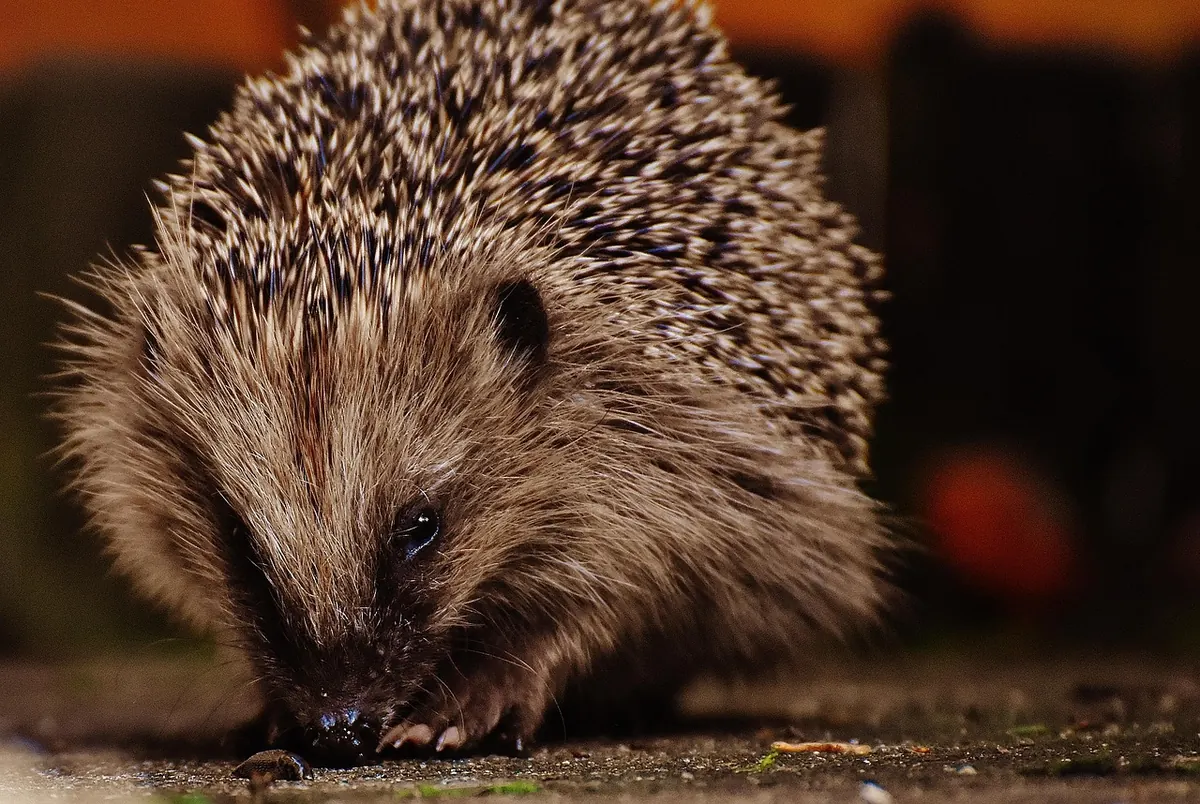
A hedgehog print is tiny, roughly 2–3cm across, and looks a little like a small hand. All four feet show five splayed toes around a broad pad, with claws registering as fine dots ahead of the toes. The front print is shorter and wider than the hind, which stretches out and often leaves a longer, narrower impression. Because hedgehogs shuffle rather than stride, the prints sit close together and wander — there's nothing tidy or military about a hedgehog's trail.
The droppings are easier to spot than the prints: cylindrical, roughly 4–5cm long, dark and slightly shiny when fresh, and usually studded with the shiny wing cases and legs of beetles. Crucially, they're left singly. If you find a cluster of black sausages arranged in a pit, you're looking at a badger, not a hedgehog.
Hedgehogs also leave a surprisingly neat calling card at fence lines: a gap. They will push through the same small space night after night, polishing it smooth. A 13cm square hole — about the size of a CD case — is the standard hedgehog highway, and if you find a worn gap under a gate, that's a strong hint something spiny is using it.
Badgers: latrines, snuffle holes and a wide shoulder
Badgers are the heavyweight of the night garden, and they leave heavyweight evidence. A badger print is broad and unmistakable: five toes set in an arc, long stout claws pointing forward, and a wide kidney-shaped pad with a clear gap between pad and toes. The front foot can be 5cm or more across. Badgers walk with a rolling, flat-footed gait, so you often get a line of prints plus a faint drag mark where the belly or a trailing foot has brushed the ground.
Their droppings are deposited in latrines — shallow scraped pits, often dug at territory boundaries or at regular points along a well-used path. Badgers use them repeatedly but do not use them as toilets in the way cats do; the pits are social noticeboards as much as anything. You'll often find them on a mound, a tussock or the edge of a lawn, sometimes several in a line.
Then there are the snuffle holes: small conical pits, like someone has jabbed a finger into the turf, usually in clusters where the badgers have been hunting leatherjackets and earthworms. A lawn that looks fine at bedtime and perforated by morning is very often badger work.
Foxes: scent, scat and a scream in the dark
That scream across the frost is usually a vixen, and it's one of the most misidentified sounds in Britain — half the neighbourhood assumes someone is being murdered. The scat is equally distinctive. Fox droppings are twisted and tapering, often 8–10cm long, dark, and frequently full of fur, feather or small bones. They are left in prominent places: on top of a wall, on a stone, in the middle of a path, on the garden bench. Prominence is the point. Foxes are advertising.
Fox prints are neat and narrow, with four toes and claws usually visible — unlike cats, foxes can't retract their claws. You'll often see them in a straight, purposeful line, one print landing almost exactly in front of the last. A dog's trail wanders; a fox's usually means business.
The small stuff: mice, voles, rats and bats
Small mammal signs are mostly about droppings, and once you've got the size and shape fixed in your head you'll never confuse them again.
- Mouse: 3–6mm, pointed at both ends, scattered loosely
- Rat: 12–20mm, spindle-shaped with blunt ends, often along a wall or in a run
- Bat: 4–8mm, dark, and when you crumble one between finger and thumb it breaks into shiny specks of insect wing — mouse droppings just smear
- Rabbit: round, dry pellets about 1cm across, often in loose heaps in short grass
Voles deserve their own mention because they leave runs rather than latrines: narrow tunnels through long grass, worn down to bare soil, with droppings scattered along them and grass stems nibbled off at a neat 45-degree angle, like tiny secateurs.
Runs, trails and tunnels
Not everything is a dropping. Some of the best evidence is structural:
- A flattened, polished path along a hedge bottom or under a gate — badger, fox or hedgehog highway
- Narrow grass tunnels with no roof — field vole
- Well-worn runs in rough grass, often in a network — rabbit
- Conical mounds of soil on a lawn, sometimes a dozen at once — moles, obviously, but worth checking the run of them because moles follow their own straight lines
- A cleared, smooth gap under a shed or decking — usually rat, sometimes hedgehog
The lookalikes: cats, dogs and confusion
Most misidentification happens at the domestic end of the spectrum. A neighbour's cat can produce a fox-like scat and prints that look vaguely four-toed, which is why the details matter. Cats leave no claws in the print, because they're retracted; the pad is a neat rounded triangle rather than a broad kidney; and the trail is usually aimless. Dogs leave claws, but a blunter, rounder print than a fox and a trail that zigzags while it reads the news.
Rule of thumb: five toes means badger, hedgehog or squirrel. Four toes means cat, dog, fox or deer. Two toes means deer, and nothing else in a British garden.
Deer prints are cloven, heart-shaped slots, pointed at the front and wider at the back. Muntjac and roe both visit suburban gardens, and both leave browsing damage — shoots bitten off with a ragged, torn edge rather than a clean cut, plus frayed bark on young trees where a buck has been rubbing.
Feeding damage and digging
Feeding signs are often the loudest clue of all, and they're seasonal. Squirrels strip bark from branches in spring and leave shredded cones in messy heaps. Mice leave cones nibbled more tidily, often with the scales removed in neat rows. Badgers punch holes in lawns. Foxes dig small excavations under fences, presumably just to see what's there. Slugs and snails leave shredded, lacy leaves and silver trails. If something has been at your bulbs, you can usually blame squirrels, mice or — in a good year — a badger with ambitions.
Keeping a record: making your survey worth something
A notebook is the difference between a nice morning wander and actual data. Record what you found, where, and when, and after a few weeks you'll start seeing patterns — a hedgehog latrine-free but regular on the same stretch of path, a fox route that shifts with the seasons, badgers only appearing after rain.
Better still, send it somewhere useful. Records of hedgehogs, bats, badgers and other mammals are genuinely valuable to local mammal groups and national recording schemes, and garden records are often the least well-covered part of the map. A cheap trail camera left out overnight will also confirm what the prints only hint at, and a torch with a red filter lets you watch without spooking anything.
A word on safety and etiquette
- Don't handle droppings with bare hands, and wash thoroughly afterwards — some wildlife-borne infections are unpleasant
- Wash garden produce, especially anything grown low to the ground
- Don't disturb setts, dens or nests, and keep dogs away from them
- Check long grass before strimming — hedgehogs and frogs both come off badly
- Never leave out milk or bread for hedgehogs; water and proper hedgehog food, or nothing at all
Read a garden this way for a season and it stops being a lawn with some bushes around it. It becomes a junction — a set of routes, territories and appointments that run on their own timetable, entirely without your permission. All you have to do is get up early enough to see the receipt.
Photo: Alexas_Fotos / Pixabay